Molding Inductors(Molded Inductor) As a core passive component in power electronic systems, the electromagnetic properties of its core material directly determine the inductor’s performance in audio signal chains. In applications such as high-end audio systems, headphone drivers, and portable audio amplifiers, inductors not only perform filtering and energy storage functions but also have a profound impact on sound quality within the signal path.
This article focuses on three common magnetic particle materials—Pure iron powder(Iron Powder),Iron-Silicon-Aluminum Alloy Powder(Fe-Si-Al Alloy Powder, Sendust),Nickel-based alloy powder(Nickel-based Alloy Powder)—Taking this material as the subject, this study systematically analyzes the mechanisms by which it affects audio quality from five dimensions: electromagnetic parameters, frequency response characteristics, total harmonic distortion (THD), dynamic response, and subjective listening perception.
I. Basic Electromagnetic Properties of the Three Materials
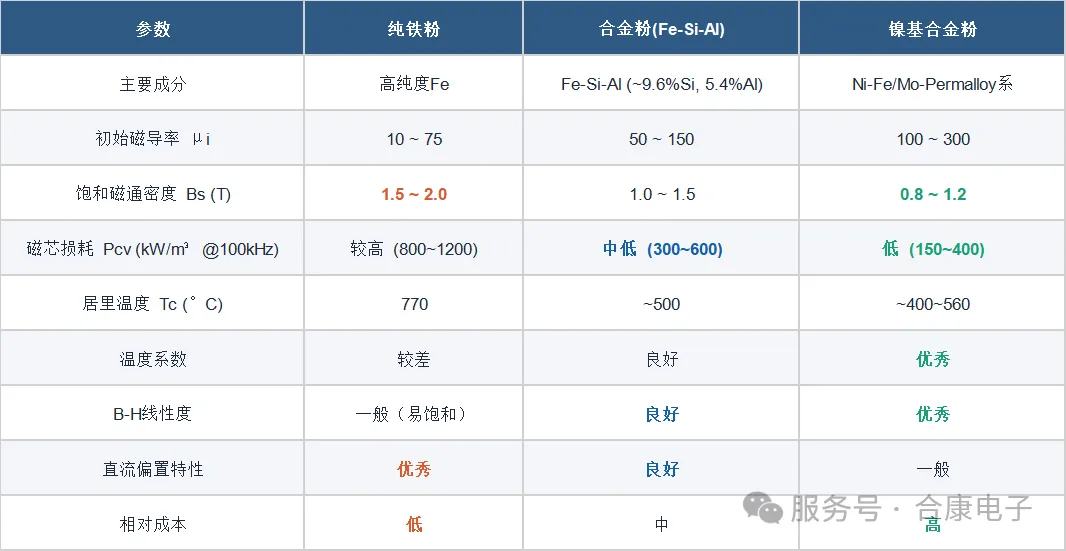
II. The Core Mechanism by Which Materials Affect Sound Quality
Frequency Response
The magnetic permeability-frequency characteristics of an inductor’s magnetic core directly determine the device’s impedance performance across different frequency bands. The audio bandwidth ranges from 20 Hz to 20 kHz, requiring the inductor to maintain stable impedance and low loss throughout this entire frequency range.
1. Iron powder
It has low magnetic permeability but high saturation flux density, allowing it to handle large signals without saturation in the low-frequency range (20–200 Hz), resulting in ample low-frequency output power; however, in the high-frequency range (5–20 kHz), core losses rise sharply, causing signal attenuation and insufficient high-frequency extension.
2. Alloy Powder
It has moderate magnetic permeability, good linearity in the hysteresis loop, low and uniformly distributed losses across the entire frequency range, and the flattest frequency response curve.
3. Nickel-based alloy powder
High magnetic permeability enables rapid impedance establishment in the low-frequency range and provides high small-signal sensitivity; extremely low core loss ensures lossless signal transmission in the high-frequency range, resulting in a smooth and natural high-frequency response.
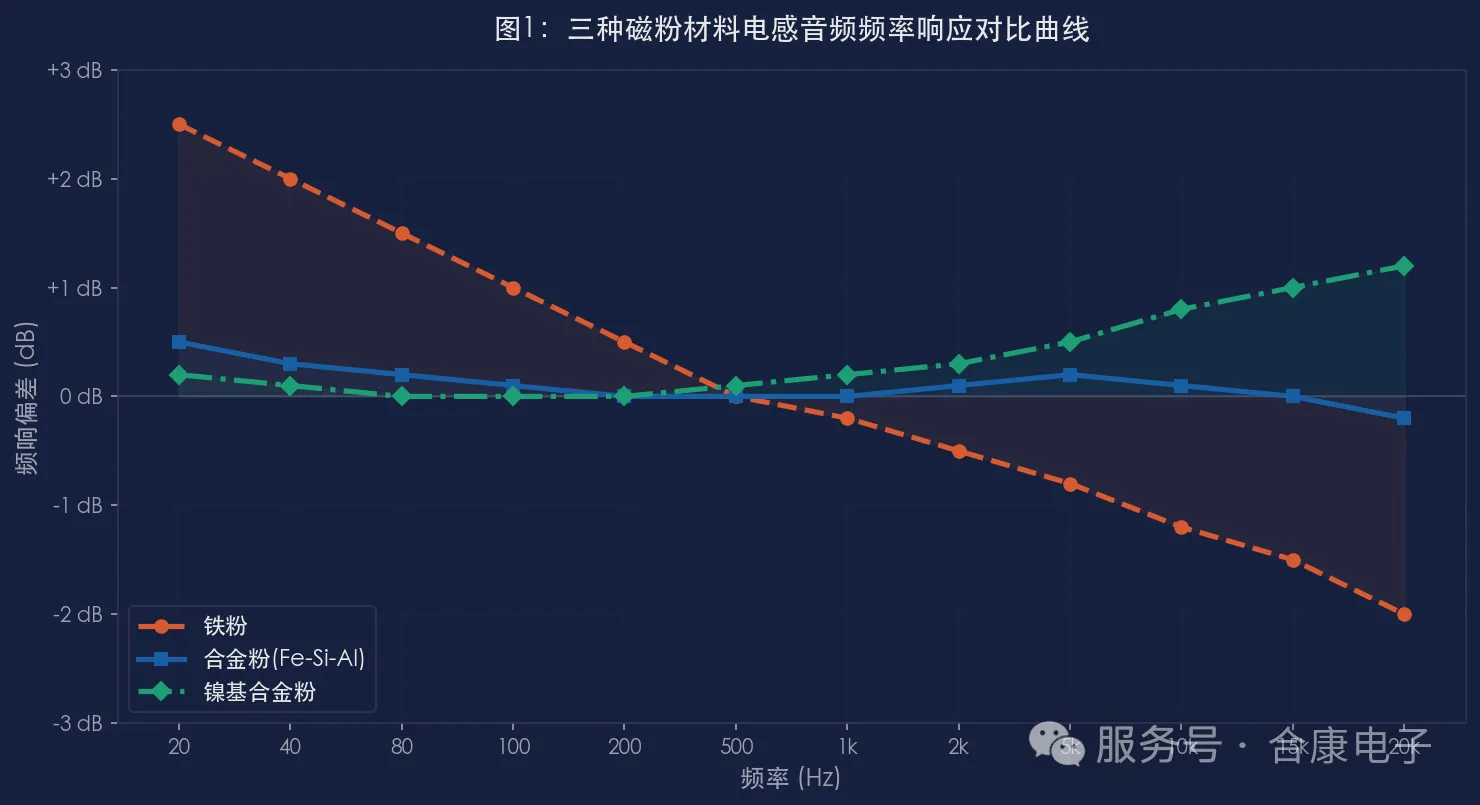
Iron Powder
Low-frequency range (20–100 Hz) deviation: +1.0 to +2.5 dB; the mid-frequency range is relatively flat; the high-frequency range (5–20 kHz) shows an attenuation of -0.8 to -2.0 dB, resulting in an overall warm sound characterized by a “boost in the low frequencies and a roll-off in the high frequencies.”
Alloy Powder
With full-band deviation controlled within ±0.5 dB, it is the material that most closely approximates the ideal frequency response curve among the three.
Nickel-based alloy powder
The low-frequency range is slightly attenuated (-0.2 to 0 dB), but the high-frequency range (5–20 kHz) features a smooth boost of +0.5 to +1.2 dB, resulting in an overall bright sound characterized by “crisp highs and strong resolution.”
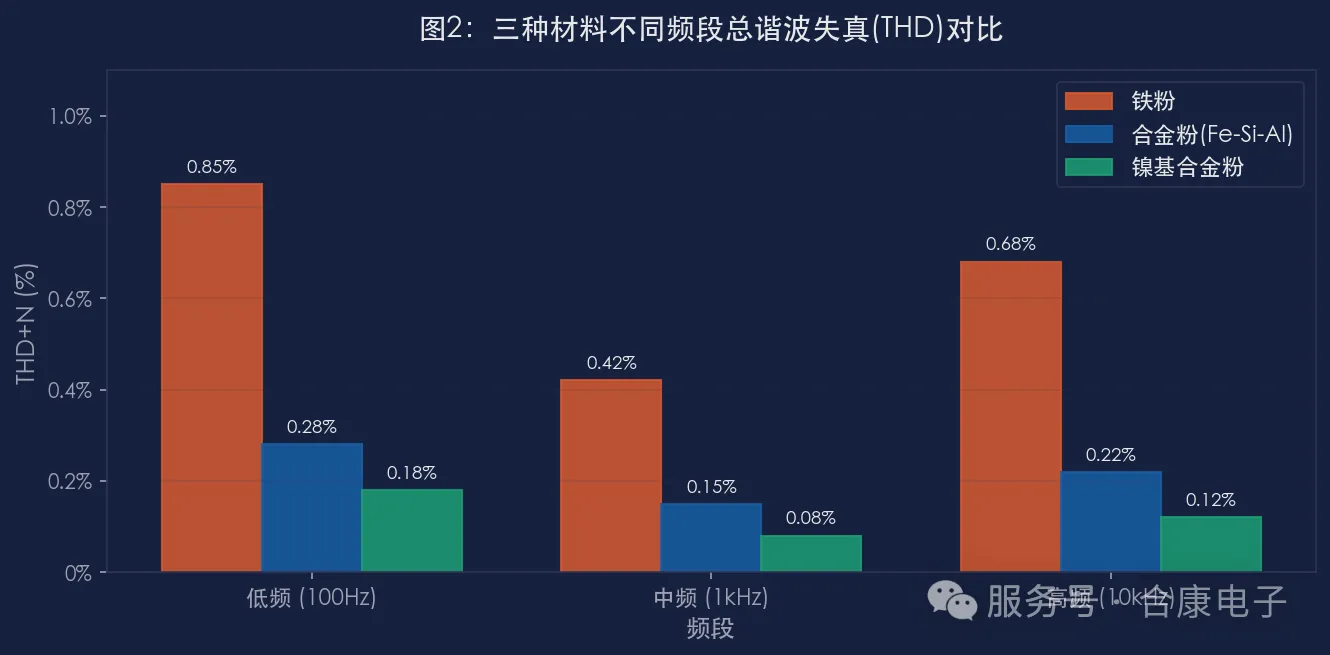
Total Harmonic Distortion (THD)
The nonlinearity of the B-H hysteresis loop in the core material is the fundamental cause of harmonic distortion in inductors. When an audio signal causes the core to operate in the nonlinear region, the signal waveform becomes distorted, generating harmonic components that are integer multiples of the fundamental frequency.
1. Iron powder
The B-H curve exhibits the highest degree of nonlinearity and high hysteresis loss. Under conditions of large dynamic signals (such as low-frequency drum sounds or large-scale symphonic music), THD rises significantly, particularly in the low-frequency range below 200 Hz, where second- and third-order harmonics are pronounced.
2. Alloy Powder
The magnetostrictive coefficient of iron-silicon-aluminum alloys is close to zero (λs ≈ 0), the B-H curve exhibits excellent linearity, and THD remains low across the entire frequency range.
3. Nickel-based alloy powder
High magnetic permeability results in an extremely narrow hysteresis loop, providing optimal linearity within the effective magnetization range and the lowest THD, with particularly outstanding performance in the region of weak signals (high-frequency details and overtones).
Dynamic Response and Transient Characteristics
Transient response measures an inductor’s ability to track rapid changes in a signal. Transient signals in music—such as the initial transients of percussion or the impact of a piano key strike—place demanding requirements on inductors.
1. Iron powder
Its high saturation magnetic flux density gives it excellent dynamic headroom. It is resistant to saturation and distortion under strong signal transients (such as drums and bass), delivering the strongest “impact” and “punch” in the low frequencies. However, at the micro-dynamic level (such as the subtle nuances of a string instrument’s bowing), nonlinearity results in a lack of clarity in the finer details.
2. Alloy Powder
Balancing dynamic range and linearity, it delivers a fast and stable transient response—neither overemphasizing nor over-compressing—resulting in a natural and balanced sound.
3. Nickel-based alloy powder
High magnetic permeability allows even minute changes in the signal to elicit a sufficient magnetization response, resulting in exceptionally rich micro-dynamic detail. However, due to its low saturation flux density, soft saturation compression may occur under extremely high dynamic range conditions, and its low-frequency “impact” is slightly inferior to that of iron powder.
Phase Characteristics and Sound Field Performance
Differences in high-frequency loss among various magnetic powder materials result in varying degrees of phase shift. Phase distortion compromises the accuracy of sound localization and the clarity of the sound.
1. Iron powder
Significant phase shift in the high-frequency range, resulting in a somewhat diffuse soundstage and a lack of "airiness" in high-frequency details.
2. Alloy Powder
Low phase distortion and excellent consistency across the entire frequency range, with precise soundstage localization and a natural sense of space.
3. Nickel-based alloy powder
It features minimal high-frequency phase distortion, exceptional soundstage transparency, precise imaging, and a rich “airy” quality.
III. Comparison of Subjective Listening Impressions
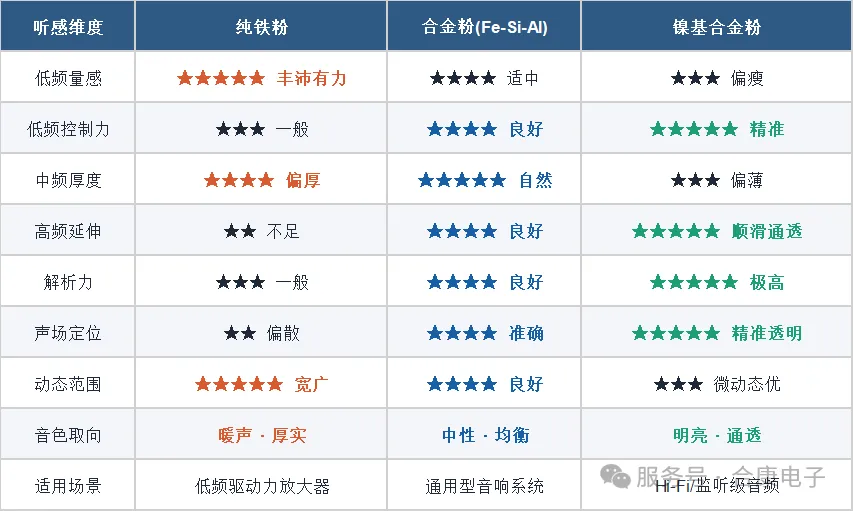
IV. Comprehensive Analysis and Recommendations for Material Selection
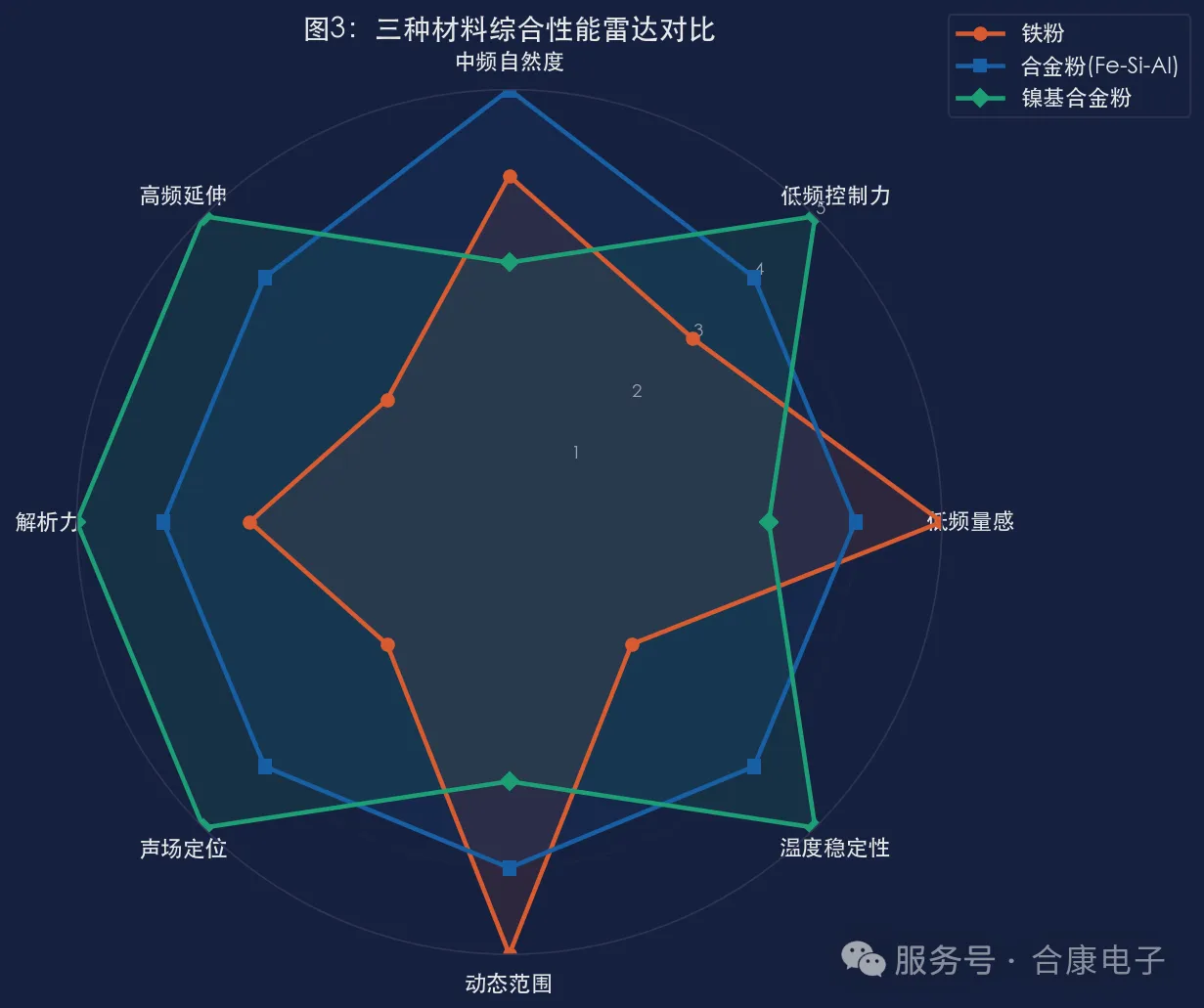
1.Powered Speakers Designed for Low-Frequency Drivers(e.g., subwoofer amplifiers, car subwoofers): RecommendedIron Powder. Its high saturation magnetic flux density and high dynamic handling capacity ensure that high-current signals in the low-frequency range pass through without distortion, providing ample low-frequency driving power.
2.General-Purpose Audio System(e.g., desktop speakers, Bluetooth speakers, general-purpose audio amplifiers): RecommendedAlloy Powder. Its full-range equalization delivers a neutral, natural listening experience across all music genres, offering the best value for the price.
3.Hi-Fi and Studio-Grade Audio Equipment(e.g., high-end headphone amplifiers, Hi-Fi amplifiers, professional monitoring systems): RecommendedNickel-based alloy powder. Its extremely low distortion and smooth high-frequency extension give it an unmatched advantage in terms of detail reproduction and soundstage transparency.
4.Hybrid Application Solutions: In high-end audio systems, inductors made of different materials can be used at various points in the signal path—iron powder in the power output stage to ensure dynamic range, alloy powder in the signal filtering stage to ensure balance, and nickel-based alloy powder in the preamplifier stage to ensure resolution—thereby achieving a synergistic effect where “1+1+1>3.”
V. Conclusion
The core material of a monolithic inductor is one of the key factors affecting audio quality. Each of the three materials has its own distinct characteristics:
• Pure iron powder: With high saturation magnetic flux density and a wide dynamic range as its strengths, it delivers rich low-frequency energy and impact to the sound; however, high-frequency roll-off and distortion limit its resolution and transparency.
• Iron-Silicon-Aluminum Alloy Powder: With its core strengths—a balanced full-range frequency response, low THD, and excellent linearity—it is the most cost-effective general-purpose choice, suitable for the vast majority of audio applications.
• Nickel-based alloy powder: With its extremely high magnetic permeability, minimal core loss, and narrowest hysteresis loop as its technical foundation, it delivers outstanding performance in high-frequency extension, subtle dynamic detail, and soundstage transparency, making it the material of choice for Hi-Fi audio.
In actual engineering practice, the selection of materials requires a comprehensive consideration of multiple factors, including the target product’s tonal character, cost constraints, power rating, and operating temperature. Understanding the electromagnetic properties of each material and its impact on audio signal transmission is essential for making the right material selection decisions.